Night of the Living Dead: The $114,000 Movie That Invented the Zombie — and Lost Its Copyright
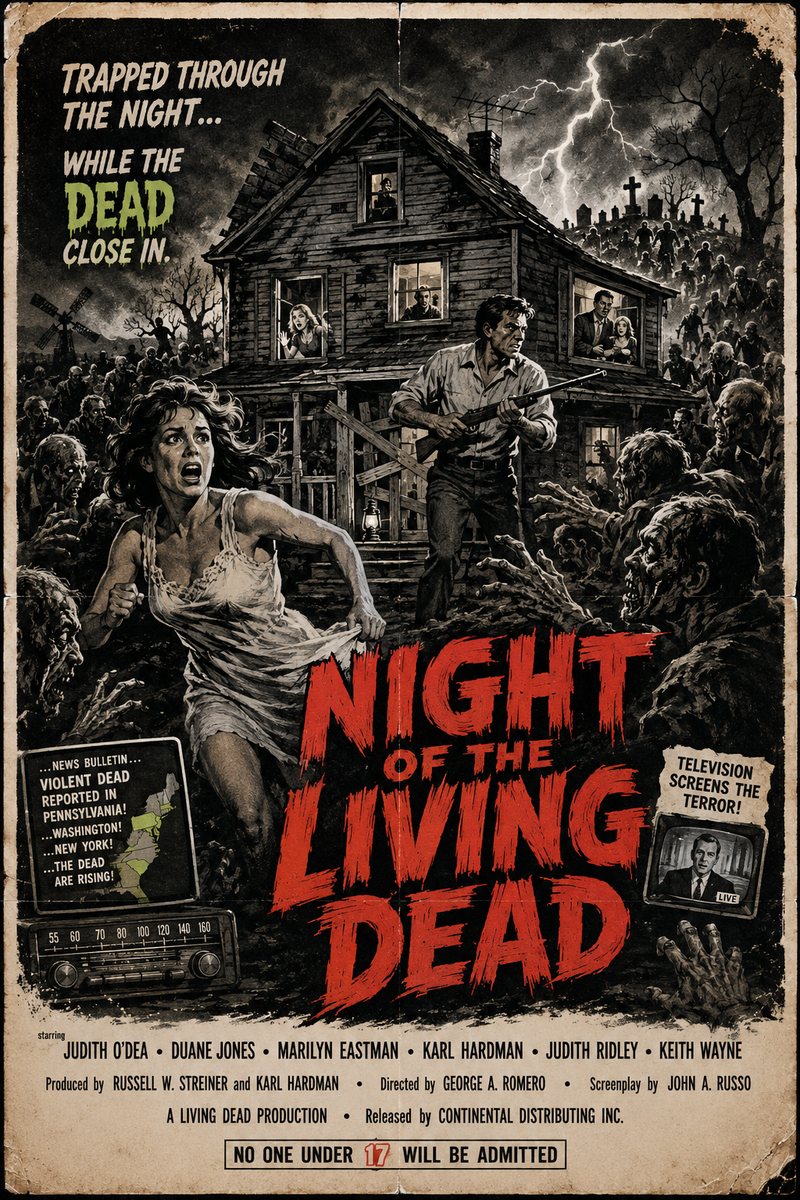
On the night of October 1, 1968, an audience at the Fulton Theater in downtown Pittsburgh watched a low-budget black-and-white horror picture made by a crew of local advertising men. Nobody in that room could have guessed they were watching one of the most influential films ever made in America — or that, thanks to a single line of text missing from its opening titles, the film had already slipped out of its makers' hands and into the public domain the moment it hit the screen.
Night of the Living Dead invented the modern zombie, launched independent horror as a commercial force, and put a Black actor at the center of an American genre film at a moment when that almost never happened. This is the story of how it got made, why it shocked the country, and how a clerical error gave it away to everyone.
Pittsburgh ad-men with a movie camera
George A. Romero was not a Hollywood director. In the mid-1960s he was a partner in The Latent Image, a small Pittsburgh production house that shot commercials and industrial films — Romero even filmed segments for Mister Rogers' Neighborhood. Restless to make a real feature, Romero and nine colleagues and investors formed a company called Image Ten, each buying in to raise a starting fund. The total budget would eventually come to roughly $114,000 — pocket change even by 1968 standards.
Romero and co-writer John Russo built their story from a simple, brutal idea, openly inspired by Richard Matheson's novel I Am Legend: the recently dead rise and feed on the living, and a handful of strangers barricade themselves in a lonely farmhouse to survive the night. The word "zombie" is never spoken in the film. The creatures are only ever called "ghouls" — and yet this is the movie that defined what the entire world now means by the word zombie: the shuffling, flesh-eating, endlessly multiplying dead.
Chocolate syrup and butcher-shop meat
The production was pure regional ingenuity. The crew shot in and around a condemned farmhouse near Evans City, Pennsylvania, about 30 miles north of Pittsburgh, which the owner let them use — and eventually let them destroy. Because the film was black and white, the blood dripping down the farmhouse walls was Bosco chocolate syrup. The flesh the ghouls devour in the film's most notorious scene was real — roasted meat and entrails donated by one of the investors, who owned a chain of butcher shops.
Cast and crew doubled and tripled up on jobs. Karl Hardman and Marilyn Eastman, who play the bickering Coopers, were investors who also handled sound, makeup, and props. Producer Russell Streiner plays Johnny, the brother whose teasing graveyard line became one of horror's most quoted openings:
"They're coming to get you, Barbra…"
The film cycled through working titles — Monster Flick, Night of Anubis, and finally Night of the Flesh Eaters — a detail that sounds like trivia but turns out to be the hinge of the whole copyright story below.
The quiet revolution of casting Duane Jones
The film's hero, Ben — resourceful, commanding, and the moral center of the farmhouse — was played by Duane Jones, a Black stage actor and academic. In 1968, a Black lead in an American genre film, whose race is never once mentioned in the script, was almost unheard of. Romero always insisted there was no political calculation: Jones simply gave the best audition, and not a line was rewritten after he was cast.
But intent and effect are different things. Audiences watched a Black man slap a hysterical white woman, fight off a white mob of the dead, and survive until dawn — only to be shot by a posse of white men who mistake him (or don't) for one of the ghouls, his body hauled onto a bonfire over the end credits. Coming just months after the assassination of Dr. Martin Luther King Jr., the ending landed with a force the filmmakers never planned, and it remains one of the bleakest, most debated final images in American cinema.
"The kids in the audience were stunned"
Distributors didn't know what to do with the finished film — Columbia and AIP both passed — until the Walter Reade Organization picked it up and released it through its Continental division. Because the ratings system that became the MPAA's G/M/R/X scheme only took effect a month after release, theaters booked Night of the Living Dead the way they booked any monster picture: into Saturday matinees full of children.
The results were infamous. A young Roger Ebert attended a matinee and wrote a widely reprinted piece for Reader's Digest describing the theater: kids who came for a fun creature feature sitting in stunned silence, some crying, as the heroes died one by one and the hero was executed at dawn. Ebert didn't condemn the film itself so much as a system that let nine-year-olds wander into it unwarned. The controversy, of course, was excellent publicity.
Critics initially dismissed the film as tasteless exploitation; Variety called it an "unrelieved orgy of sadism." But it became a runaway drive-in and midnight-movie phenomenon, grossing many millions worldwide against its $114,000 cost, and critical opinion reversed within a few years — especially in Europe, where French and British critics championed it as genuine social horror. In 1999 the Library of Congress selected it for the National Film Registry as "culturally, historically, or aesthetically significant," and in 2016 the Museum of Modern Art and The Film Foundation completed a 4K restoration from the original camera negative.
The most expensive missing line of text in film history
So why can you watch this landmark, uncut and free, on The Lost Reel? Because of one omitted line of type.
Under the Copyright Act of 1909, the law in force in 1968, a published work had to carry a proper copyright notice — the © symbol, the year, and the owner's name. Publish without the notice, and the work forfeited its federal copyright protection immediately and permanently. There was no grace period and no fixing it later.
Image Ten's original prints, titled Night of the Flesh Eaters, carried a valid notice. But when the Walter Reade Organization retitled the film Night of the Living Dead, the title card was swapped — and the copyright notice on it was left off the new prints. The film was effectively published without notice. From the day it opened, anyone could legally duplicate and sell it, and for decades nearly everyone did: countless budget VHS tapes, bargain-bin DVDs, TV airings, and eventually internet streams, almost none of which paid the filmmakers a cent.
Romero called it the best and worst thing that ever happened to the film. The makers of one of the most profitable independent films ever made earned almost nothing from its afterlife — but that same free circulation is a big part of why the film saturated the culture, why every generation rediscovered it, and why the zombie became a permanent piece of global folklore. (Congress closed this trapdoor for later works: the 1976 Act softened the notice rule, and since the Berne Convention Implementation Act of 1989, no notice is required at all.)
The legacy: an entire genre with one ancestor
Every zombie story you have ever seen descends from this film. Romero's own sequels — Dawn of the Dead (1978), Day of the Dead (1985), and three more — built the mythology out, and the wider culture ran with it: The Walking Dead, 28 Days Later, World War Z, The Last of Us, zombie walks, zombie survival guides. The rules everyone "knows" — the dead eat the living, a bite dooms you, destroy the brain — were all codified in that Pennsylvania farmhouse.
The film also proved that a regional independent production, made far from Hollywood with local money and unknown actors, could out-earn and outlast studio product — a lesson that shaped independent horror from The Texas Chain Saw Massacre to Halloween to The Blair Witch Project.
Sources & further reading
- "Night of the Living Dead" — Wikipedia — production history, budget, release, and reception details.
- Roger Ebert, "The Night of the Living Dead" (1969) — the famous account of the Saturday matinee audience.
- National Film Registry — Library of Congress — the film was selected for preservation in 1999.
- U.S. Copyright Office, Circular 3: Copyright Notice — background on notice requirements under the 1909 and 1976 Acts.
- Night of the Living Dead — The Criterion Collection — on the 4K restoration by MoMA and The Film Foundation.
- Night of the Living Dead — Internet Archive — the public-domain source print streamed on The Lost Reel.